Grasp, Gaze and Graceful Lace; Gender Performance and Artistic Agency of Judith Leyster

Updated: May 3
Anyone who has worn women’s clothing—whether that be pants, skirts, or dresses—has likely encountered the frustrating absence of functional pockets; From a personal experience wearing a uniform I have dealt with the same irritating situation. Our skirts had no pockets and the blazers worn on special days had “pockets” but were unfortunately sewn shut; Impractical clothing as such forces the wearer to carry their belongings in their hands or carry a purse. A twitter post (fig. 1) with the caption “Girls hands be like”, piqued the interest of many across the platform and posts discussing this phenomenon can be found on other apps to this day. On Instagram an account by the name “@girlscarryingshit” is dedicated to posting pictures of women doing just that. The response to the original post reads “That’s years of evolutionary adaption due to the lack of pockets in women’s clothes”.
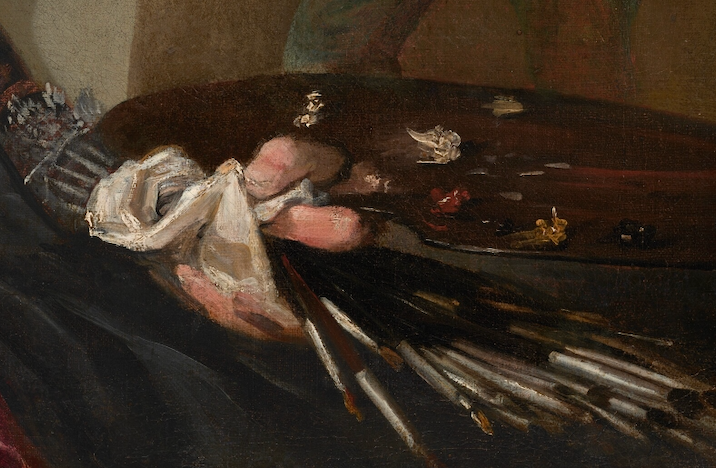
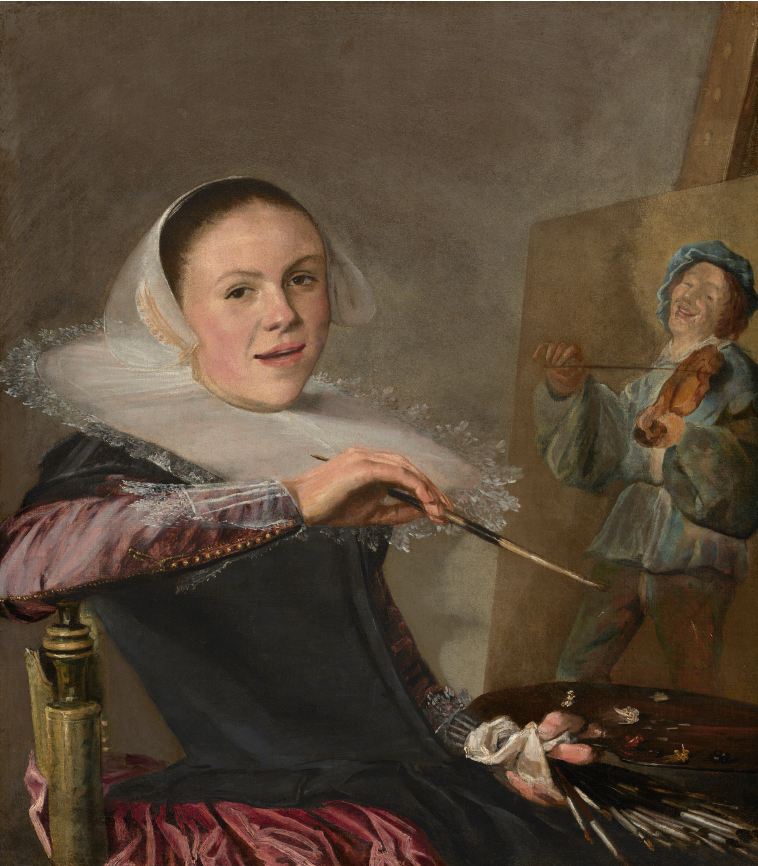
This modern phenomenon I have chosen to refer to as the “girl grip” can also be found within the context of art history and the gender roles of Dutch women in the 17th century. Just like the women in the photo from “Girls hands be like”, Judith Leyster in her Self-Portrait (fig.2) overextends the fingers of her left hand to grasp tightly onto a rag, a paint palette and roughly 20 paintbrushes. This parallel provides a unique analysis; the elegant yet impractical fashion coupled with the grasp of her artist materials speaks to Leyster’s ability to figuratively and literally grasp her artistic practice despite the societal disadvantage of her gender. Using Judith Butler’s Gender Trouble as a framework for analyzing this painting, it is established that while
Judith Leyster adheres and conforms to the expectations of her femininity through her elaborate, lacy costume seen in her Self-Portrait, Leyster simultaneously defies this paradigm through her depiction of grip and gaze.
In Judith Butler’s 1990 book titled Gender Trouble: Feminism and the Subversion of
Identity The gender theorist argues that gender is not an innate identity but rather a series of repeated acts, behaviors, and gestures that are shaped by culture and performed for society. While not in Gender Trouble, Butler writes in Imitation and Gender Insubordination that "Gender is a kind of imitation for which there is no original; it is a performance that produces the effect of an inner core of gender identity"i. This assertion provides a useful framework for understanding Judith Leyster’s Self-Portrait. Through her clothing, gaze and pose, Leyster performs gender in a way that both adheres to and subverts the norms of the Dutch Baroque world. Butler also shares how “The effect of gender is produced through the stylization of the body and, hence, must be understood as the mundane way in which bodily gestures, movements, and styles of various kinds constitute the illusion of an abiding gendered self”ii. Butler’s assertion about how gender is manifested through a “stylization of the body” directly reflects
Leyster’s stylization of her own body through art. Furthermore, this quote speaks to how the viewer plays a crucial role in validating this performance of gender, interpreting her fashionable dress, lacy details and ruff collar as signs of respectability and femininity. At the same time, her confident pose and direct gaze challenge the viewer’s expectations, forcing them to reconsider their assumptions about gender and artistry. In this way, Leyster’s self-portrait not only reflects the constructed nature of gender but also invites the viewer to participate in its ongoing negotiation. Butler’s theory that gender is performative, a stylized repetition of acts, is especially evident when considering the intersection of fashion and self-representation in Leyster’s
painting. The overwhelming amount of lace, while symbolizing domestic virtue, is itself a part of this performative identity. The intricate and time-consuming nature of lacemaking parallels the intricate performance of femininity required of a woman in Leyster’s society. Through her Self Portrait, Leyster constructs an image that reassures the viewer of her domestic virtue while simultaneously asserting her professional identity, thereby performing both womanhood and artistry in a calculated and layered fashion.
Judith Leyster was born in The Netherlands in a town called Haarlem. She was born and baptized on July 28th, 1609, to a non-artistic family, rather her family owned a brewery called “The Leyster”iii. In 1628, Samuel Ampzing published a description of the town of Haarlem where he mentioned Judith as an active artist in the community. Seeing as she would have just been nineteen years old, Judith Leyster was making a name for herself as an artist from a very young age. Following this publication, the Leyster family moved around towns in the Netherlands, and many speculate at this time Judith may have been influenced by the Utrecht Caravaggism iv, whether that be from her family’s time in Utrecht or from the movements influence on artists such as Frans Hals in Haarlem. Landing back in Haarlem 1631 for the baptism of one of Hal’s children, Leyster would achieve a degree of professional success and be the first woman to be admitted to the Saint Luke’s Guild of Haarlem as a Master painter. In the
Dutch Baroque world most women learned to paint if they came from a family of artists or relied on societal connections to take up the skill therefore, Judith Leyster’s acceptance to the Guild in Haarlem is a remarkable feat and a testament to her dedication to her craft. The perspectives of her work cater to no gender in particular. Judith’s priorities lied with meeting the expectations of the art market and highlighting her technical abilities as an artist. She was known for painting various styles, themes and subjects v but mostly she focus on genre paintings for the middle class.
Welu writes that Judith’s daily life scenes “reflect not only the preferences of buyers, but also the moral values of seventeenth-century Dutch society, with many realistic elements in these pictures being symbolic”vi. Through her self-portrait Judith Leyster actively appeals to the desires of the art market in more ways than one.
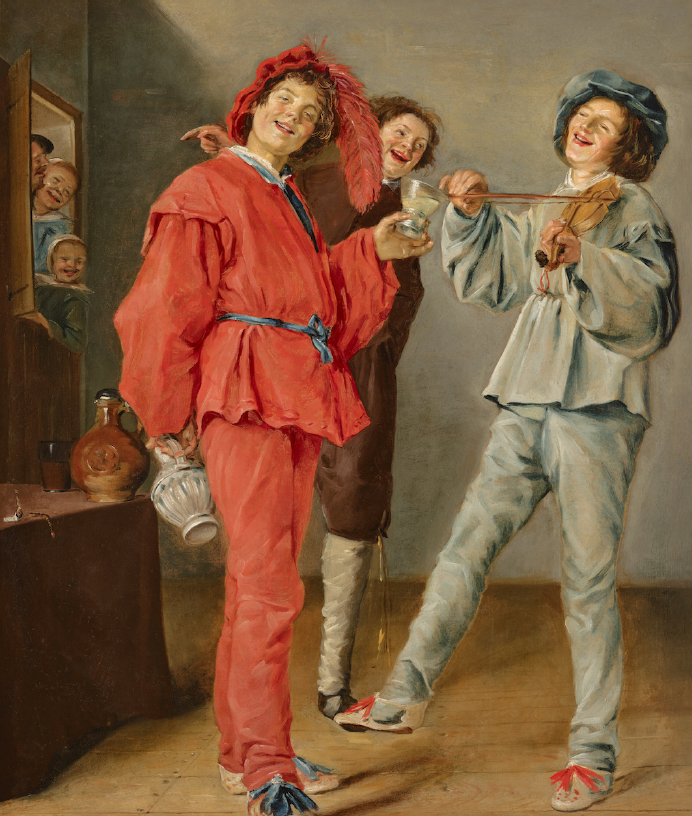
In looking at Judith Leyster’s Self Portrait, viewers see the young artist turned away from the easel to gaze upon the viewer. Her eyes are direct in their stare, her mouth is slightly opened as if to greet the viewer and yet something about her facial expression feels tongue in cheek, ever so slightly insincere. Nevertheless, the figure portrayed is confident in their profession and comfortable with themselvesvii. One arm is perched casually on the back of her chair, delicately holding her paintbrush out towards the canvas, while her other arm is resting on her lap; she can be seen gripping upwards of twenty paintbrushes, a paint palette, and a rag all with one hand. Her body is covered in fashion of a respectable and high-class Dutch woman in the 17th century; She wears a black gown with a structured bodice and pink silk details, an outrageously large and stiff lace ruff sticks out from her neck, and delicate lace cuffs adorn her wrists. Her hair is slicked back and mostly covered by the also lacey diadem like cap. On the canvas before her is the beginnings of a painting of a fiddle player. Paintings as such were a popular at the time, displaying a company of musicians, dancers, and actors in costume viii. Judith Leyster’s, The Merry Company painting (fig. 3) reflects the fiddle player seen in Leyster’s Self-Portrait. Leyster’s choice in painting both a self-portrait where she is adorned in fanciful clothing as well as her genre painting was direct and calculated. Leyster was keenly aware of the desires of the art
market, and she used her Self-Portrait as a means to appeal to audiences and situate herself as a Dutch Master. The art market, particularly, art collectors, had a curiosity and interest in female self-portraits due to their rarity before the 20th centuryix. Women artist faced certain cultural taboos that linked self-representation with vanity, making female self-portraits both scarce and loaded with meaningx. This historical context proves important in the analysis of Leyster’s Self-Portrait seeing how Leyster again positioned herself to appeal to various individuals in the art market. It is through this painting that she shows viewers and prospective commissioners her ability to paint across genres as well as her technical ability to paint intricate lace and clothing for portraiture.
The amount of lace seen in Leyster’s self-portrait paired with the cultural context of lace and lace making proves to be significant. Lace, often associated with ideas of femininity and luxury was taught to women from a very young age, highlighting the social dynamics of the time xi. The act of lace making in the 17th century served as a mode of income for women of all classes. Subsequently the art of lace and lacemaking became symbols of domesticity, adorning the home and the body while demonstrating women’s virtue and diligence xii. The immense amount of lace incorporated in Leyster’s self-portrait was done intentionally to highlight her emphasize both her femininity and her commitment to being a Dutch Master. The presence of lace in portraits serves as a marker of gender performance in its own way; lace becomes a marker of social status and an assertion of moral virtue. In choosing to adorn herself in such an abundance of lace, Leyster displays her feminine respectability, positioning herself not only as
an accomplished and skillful artist but also as a proper woman within her society. This strategic self-fashioning reveals how deeply intertwined gender, labor and appearance were during the Dutch Golden age.
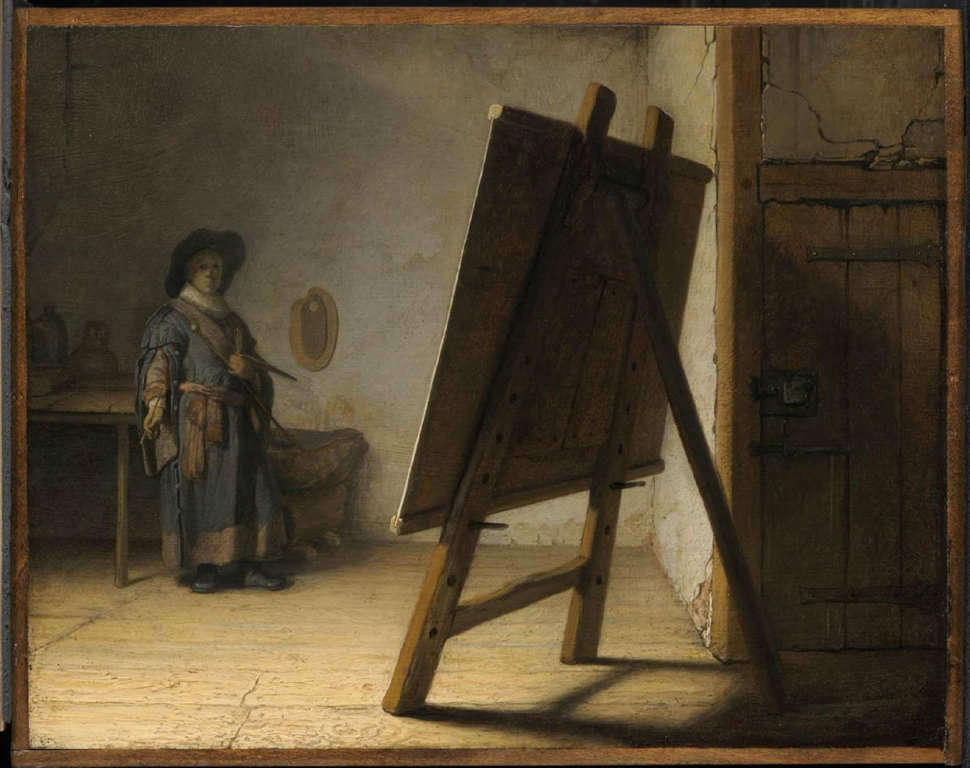
To achieve a well-rounded analysis and understanding of Judith Leyster’s Self-Portrait it is important to bring in comparisons. Rembrandt’s Self-Portrait with Easel (1628-1629) (fig. 4) presents a scene like Leyster’s. Both self-portraits portray the artist as they work. In Rembrandt’s work, the artist is placed in the corner of a shadowy room and stands to ponder what to create next. A giant easel dominates in the foreground partially hiding the artist but not revealing what lies upon it. The mood of the painting comes across as serious and emphasizes the solitude and labor involved in Rembrandt’s artistic practice. With the artist being tucked back in the corner of
the scene and the massive canvas standing at the forefront Rembrandt presents himself primarily through the work rather than the self. The painting centers around the canvas not the subject of the self-portrait. Like Leyster he holds many paintbrushes in one hand and a single one in the other. However, Rembrandt’s grip on these artist materials is not accentuated by any means. This self-portrait highlights the mental process of the artist; how physical technique and thought are equally important to one another. Rembrandt chooses to keep the front of the canvas as a mystery to the viewers which is significant. This speaks to how Rembrandt did not have to assert
his skills to viewers; his existence in that space as a male artist goes unchallenged. In contrast, Leyster’s Self Portrait insists on visibility. She is portrayed up close and personal, facing the viewer directly confidently gripping her artist materials in a way that is both graceful and powerful. Where Rembrandt’s gender simply allowed him to be an artist, Leyster’s femininity requires her to prove her legitimacy. Through her elaborate costume, tight grip and direct gaze, Leyster consciously performs both artistic mastery and social respectability, navigating a space that Rembrandt could occupy without challenge.
This distinction between Leyster and Rembrandt reinforces the necessity of visibility for women artists in the Dutch Baroque period. Leyster’s grasp on her artistic tools becomes a visual metaphor for her determination to claim her place in the male-dominated field. Returning back to the concept of the “girl grip”, the act of holding many objects at once – born out of the impracticality of women’s clothing – is not merely an amusing social observation of our modern world but rather a lens through which we can view historical gendered experiences. The persistent necessity for women to compensate for structural limitations, whether by improvising carrying methods or by over-performing professional skills, ties the “girl grip” phenomenon
directly to Leyster’s own balancing act between artistry and gender expectations.
In conclusion, Judith Leyster’s Self-Portrait offers more than just a glimpse into the
technical skill of a Dutch Master in the Golden Age; it captures the layered performance required of a woman artist negotiating gendered expectations. Through her confident gaze, elaborate lace fashion, and the powerful grip on her artistic tools, Leyster asserts both her femininity and her professional authority as a Dutch Master. The modern “girl grip” phenomenon provides a relatable entry point into understanding how women across history have adapted to structural barriers, improvising ways to assert agency and skill. When viewed through the lens of Judith Butler’s theory of gender as performance, Leyster’s Self-Portrait reveals the strategic self fashioning necessary for women to carve out spaces of visibility and legitimacy. Her work remains a testament to the resilience and adaptability required of women in both art and life, across centuries.
Endnotes:
i Butler, Judith. Imitation and Gender Insubordination. 1991. 313
ii Butler, Judith. Gender Trouble. Routledge, 2006. 140
iii Hofrichter, Frima Fox. Judith Leyster: A Woman Painter in Holland’s Golden Age. Davaco,
1989. 13
iv Judith Leyster: A Woman Painter in Holland’s Golden Age. 14
v Judith Leyster: A Woman Painter in Holland’s Golden Age. 23
vi Welu A. James, Biesboer, Pieter A Dutch Master and Her World. Yale University Press, 1993.
11
vii Borzello, Frances. Seeing Ourselves: Women’s Self-Portraits. Harry N. Abrams, Inc, 1998. 53
viii Brenner, C, et al. Painting in the Dutch Golden Age: A Profile of the Seventeenth Century.
National Gallery Of Art, 2007. 42
ix Seeing Ourselves: Women’s Self-Portraits. 26
x Peacock, Martha Moffitt. Mirrors of Skill and Renown: Women and Self-Fashioning in Early-
Modern Dutch Art. Mediaevistik, vol. 28, 2015, JSTOR. 326
xi Standen, Edith Appleton. The Grandeur of Lace. The Metropolitan Museum of Art Bulletin,
vol. 16, no. 5, 1958, JSTOR. 158
xii Wendler, Jenna Ideals of Femininity in the Dutch Republic: Analyzing Systems of Class,
Gender, and Power in Caspar Netscher's Lacemaker (1662), Master's Capstone Project,
American University, 2022
Bibliography
Alper, Svetlana “The art of describing : Dutch art in the seventeenth century” Free
Download, Borrow, and Streaming : Internet Archive. (1984). Internet Archive.
Ball, Willietta Goddard. “LACE IN PORTRAITURE.” The Brooklyn Museum Quarterly,
vol. 9, no. 3, 1922, pp. 123–33. JSTOR, http://www.jstor.org/stable/26463138.
Borzello, Frances. Seeing Ourselves: Women’s Self-Portraits. Harry N. Abrams, Inc,
1998.
Butler, Judith. Imitation and Gender Insubordination. 1991.
Butler, Judith. Gender Trouble. Routledge, 2006.
Harris, B. (n.d.). SmartHistory – Judith Leyster, Self-
Hofrichter, Frima Fox. Judith Leyster: A Woman Painter in Holland’s Golden Age.
Davaco, 1989.
Honig, Elizabeth Alice. “The Art of Being ‘Artistic’: Dutch Women’s Creative Practices
in the 17th Century.” Woman’s Art Journal, vol. 22, no. 2, 2001, pp. 31–39. JSTOR,
Nijboer, Harm, et al. "The Painting Industries of Antwerp and Amsterdam, 1500–1700: A
Data Perspective." Arts, vol. 8, no. 2, 2019, pp. 77–89
Peacock, Martha Moffitt. Geertruydt Roghman and the Female Perspective in 17th-
Century Dutch Genre Imagery. Woman’s Art Journal, vol. 14, no. 2, 1993, pp. 3–10. JSTOR,
Peacock, Martha Moffitt. Mirrors of Skill and Renown: Women and Self-Fashioning in
Early-Modern Dutch Art. Mediaevistik, vol. 28, 2015, JSTOR.
Standen, Edith Appleton. “The Grandeur of Lace.” The Metropolitan Museum of Art
Bulletin, vol. 16, no. 5, 1958, pp. 156–62. JSTOR, https://doi.org/10.2307/3257694.
Welu A. James, Biesboer, Pieter “A Dutch Master and Her World”. Yale University
Press, 1993.
Wendler, Jenna "Ideals of Femininity in the Dutch Republic: Analyzing Systems of
Class, Gender, and Power in Caspar Netscher's Lacemaker (1662)," Master's Capstone Project,
American University, 2022, https://omeka.library.american.edu/s/netscherlacemaker.
Figures:
(figure 1) “Girls hands be like:”

(Figure 2). Judith Leyster, Self-Portrait, c. 1633, oil on canvas, 74.6 x 65.1 cm / 29-3/8 x 25-5/8″ (National Gallery of Art, Washington DC.)
(Figure 3). Judith Leyster, Merry Company c. 1629 74.4 x 62.9 cm. Oil on canvas, (Private collection)
(Figure 4). Rembrandt, The Artist in His Studio, c. 1628. oil on panel, 24.8 x 31.7 cm (Center for Netherlandish Art, Museum of Fine Arts, Boston)


Comments